Solving biofouling without diver intervention
Biofouling (biological growth on submerged surfaces) is one of the primary causes of data quality degradation in long-term underwater monitoring. Within weeks, algae, barnacles, and biofilm can obscure camera viewports and degrade sensor performance, requiring costly dive maintenance or data gaps.
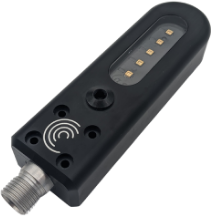
The UVC1 uses five high-powered UV-C LEDs at 275 nm to continuously inhibit biological growth on adjacent surfaces. Lightweight, low-power at 2.4 W, and ruggedized for extended underwater deployments, it mounts directly onto camera housings or sensor platforms via standard mounting holes. The C3-DBH13-UVC variant integrates the UVC1 function directly into the stereo camera housing.
Small, low-power, long-lasting
- 5 high-powered UV-C LEDs at 275 nm (the effective biofouling inhibition wavelength)
- Wide 140 degree beam angle covers the viewport and surrounding housing surfaces
- Small form factor with mounting holes for integration onto any sensor platform
- 2.4 W power draw (minimal impact on deployment power budget)
- Corrosion-resistant acetal housing with anodized aluminum back plate
- Quartz lens transmits UV-C without degradation over time
- SAE-4 vent port for pressure equalization at depth
Where the UVC1 is deployed
- Camera viewport protection: prevents algae and biofilm growth that degrades image quality
- Sensor surface maintenance: keeps optical and acoustic sensors clear between service visits
- Long-term fixed deployments: marine energy sites, ocean observatories, aquaculture monitoring
- High-biofouling environments: tropical and temperate coastal waters with heavy biological activity
- Any deployment where diver maintenance is infrequent or costly
Ready to deploy?
Talk to our team about the right configuration for your environment and use case.
Request a quote →