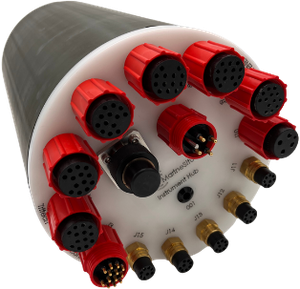
One node for the whole instrument array
The H1 is a low-cost oceanographic instrument integration hub that aggregates power and communications from shore into a single subsea node, then distributes both to up to ten individually controlled output ports. Each port can be configured to supply 5, 12, 24, or 48 VDC, support Ethernet or serial communications, or serve as a hardwired acquisition trigger, adapting to whatever instrument is connected.
All data streams are aggregated into a single 10 Gigabit connection to shore over single-mode fiber or Ethernet, at 48 VDC or 375 VDC. The hard anodized aluminum housing, double O-ring seals, and 300 m depth rating make the H1 appropriate for demanding long-term observatory deployments.
Configurable, monitored, and built to last
- 10 individually configurable and monitored output ports: 5/12/24/48 VDC, Ethernet, or serial
- 960 W total power budget (enough for dense multi-instrument arrays)
- Software-controllable hardwire trigger per output channel for instrument synchronization
- 4 single-mode BiDi fibers provide redundant, high-bandwidth connection to shore
- Up to 8 simultaneous Ethernet devices and 8 serial devices
- 9-axis accelerometer for platform orientation and motion logging
- Per-channel health monitoring: voltage, current, temperature, and humidity
- Hard anodized aluminum housing (corrosion-resistant in long-term marine environments)
- Double O-ring seals with monofilament retainer for reliable 300 m waterproofing
- 375 VDC input option for long cable runs from shore to deep deployment sites
Where H1 is deployed
- Ocean observatories: fixed-station multi-instrument platforms with shore power and communications
- Marine energy monitoring: central hub for cameras, hydrophones, ADCPs, and environmental sensors
- Long-term ecological deployments: consolidated power and comms reduces wet connector count and maintenance
- Aquaculture infrastructure: multi-sensor monitoring platforms for large offshore facilities
- Underwater vehicle docking stations: power delivery and data aggregation for AUV operations
- Research platforms: flexible port configuration adapts to evolving sensor payloads
Ready to deploy?
Talk to our team about the right configuration for your environment and use case.
Request a quote →