High-fidelity acoustics with full environmental context
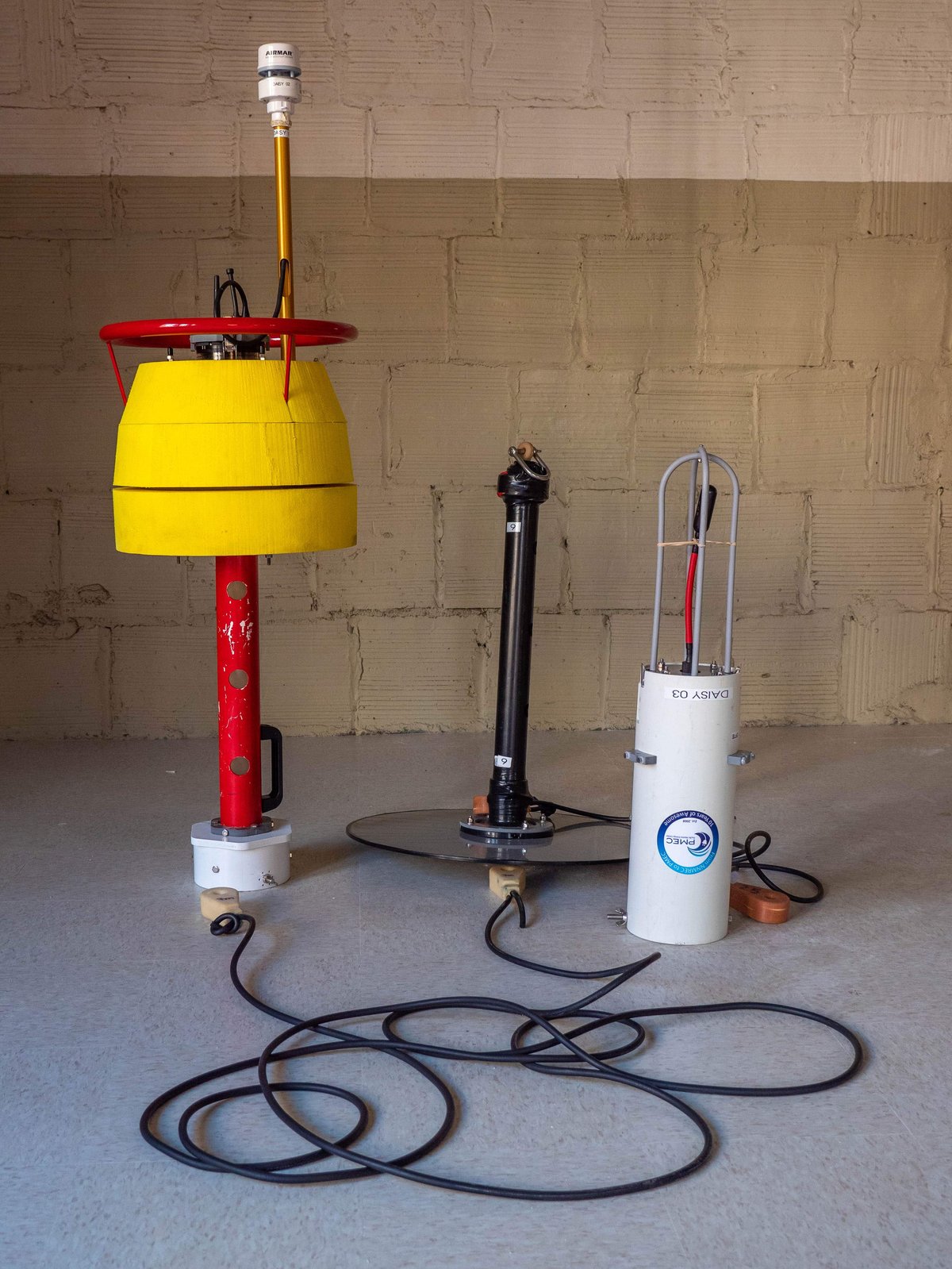
DAISYs are hydrophone systems designed to minimize relative motion between the hydrophone and the surrounding water, which is the primary source of self-noise in towed or moored acoustic instruments. Each system consists of a surface expression, a hydrophone package, and a coupling between the two that isolates the hydrophone from surface-induced motion.
Onboard microcomputers record acoustic data at up to 512 kHz alongside a continuous stream of metadata: GPS position, IMU orientation, and (depending on variant) wind speed and direction. Systems operate for up to 12 hours between charges and are light enough to deploy and recover with a crew of two. When deployed in groups around a marine energy converter, DAISYs can also localize sources of radiated noise.
Configured for your environment
C-DAISY
Surface expression connected to hydrophone package by rubber tether (1+ m length). Hydrophone surrounded by fabric flow shield to suppress flow noise.
Best for tidal and river current environments.
Shallow DAISY
Surface expression rigidly connected to hydrophone package. Simplified deployment for limited-clearance environments; rigid connection can increase self noise.
Best for tidal and river currents with limited clearance.
W-DAISY
Surface expression connected by rubber tethers (2+ m) with intermediate heave plate for motion dampening. Designed for wave-dominated environments.
Best for open-water wave energy sites.
Designed to minimize flow noise
- Drifting design minimizes relative motion between hydrophone and water, resulting in lower self-noise than towed or moored systems
- HTI 99-UHF hydrophone with up to 512 kHz sample rate for broadband acoustic monitoring
- GPS PPS synchronization for precise time-stamped acoustic records
- IMU orientation data on both surface expression and hydrophone package
- Integrated weather station captures wind speed and direction with each deployment
- Rich metadata stream accompanies every acoustic recording without separate data collection
- Up to 12 hours battery life for full tidal cycle surveys
- Lightweight and deployable by a crew of two from a small vessel
- Array deployment enables acoustic source localization around marine energy converters
Where DAISY is deployed
- Marine energy acoustic assessment: characterize noise output of tidal turbines and wave energy converters
- Marine mammal monitoring: detect and classify cetacean vocalizations at offshore energy sites
- Acoustic habitat characterization: baseline surveys for environmental impact assessments
- Tidal and river current environments: C-DAISY and Shallow DAISY variants
- Open-water wave energy sites: W-DAISY variant for high sea-state conditions
- Noise source localization: array deployments around converters and subsea structures
Ready to deploy?
Talk to our team about the right configuration for your environment and use case.
Request a quote →